Monsters

Kong (2017)
Kong from the 2017 movie Kong: Skull Island is a massive, powerful ape-like creature who stands upright like a human. He’s not just an animal,he’s a protector and the guardian of Skull Island. Towering over the landscape, Kong has immense strength, incredible agility for his size, and a deep intelligence that sets him apart. He’s covered in dark fur, with expressive eyes that reveal emotion and thought. While fierce and formidable in battle, especially when defending his territory or the island's other creatures, Kong also shows compassion and a sense of honor. He's not a mindless monster,he's a king.


Godzilla (Legendary)
"Legendary" Godzilla refers to the version of Godzilla created by Legendary Pictures as part of the MonsterVerse, a shared cinematic universe that includes other iconic monsters like King Kong.
This Godzilla first appeared in the 2014 film Godzilla, directed by Gareth Edwards. It's a modern reimagining of the classic Japanese kaiju (giant monster) created by Toho in 1954. The Legendary version is much larger and bulkier than most past iterations, giving it a more ancient, almost god-like presence.
A few key traits of Legendary Godzilla are:
-
Massive size – around 355 feet tall (in later films).
-
Atomic breath – a glowing blue energy blast, used as his signature weapon.
-
Protector role – portrayed more as a force of nature or balance-keeper than a villain.
-
Primal and ancient – often described as one of the Earth’s original titans, awakened by human activity.
Ghidorah Vs Godzilla
The battle between Ghidorah and Godzilla is a cataclysmic clash of titans, filled with raw power and elemental fury. Ghidorah, a three-headed extraterrestrial dragon, descends from the sky like a living storm, his wings whipping up hurricanes and his gravity beams crackling with devastating energy. Each of his serpentine heads lashes out independently, coordinating a relentless assault from multiple angles. His presence alone distorts the environment, commanding awe and terror.
Godzilla, the ancient king of monsters, rises from the depths of the ocean like a force of nature awakened. His thick, armored hide shrugs off attacks that would annihilate lesser beings, and his thunderous roar echoes with primal authority. As he charges into battle, the earth trembles under his massive frame. His atomic breath, a beam of concentrated nuclear fury, slices through the chaos, meeting Ghidorah’s blasts in a spectacular collision of power.
Their confrontation is brutal and unrelenting, a contest of strength, endurance, and will. Ghidorah’s speed and aerial dominance keep Godzilla on the defensive at first, raining destruction from above. But Godzilla, with his sheer resilience and indomitable spirit, adapts and strikes back with precision. Buildings crumble, skies darken, and the landscape is reshaped by their violent struggle. Each blow exchanged feels like a seismic event, with the fate of the world hanging in the balance.
In the end, it is more than just a battle of beasts. It is a mythic showdown between chaos and balance, invasion and resistance, with Godzilla standing as the planet’s last line of defense against a godlike adversary.


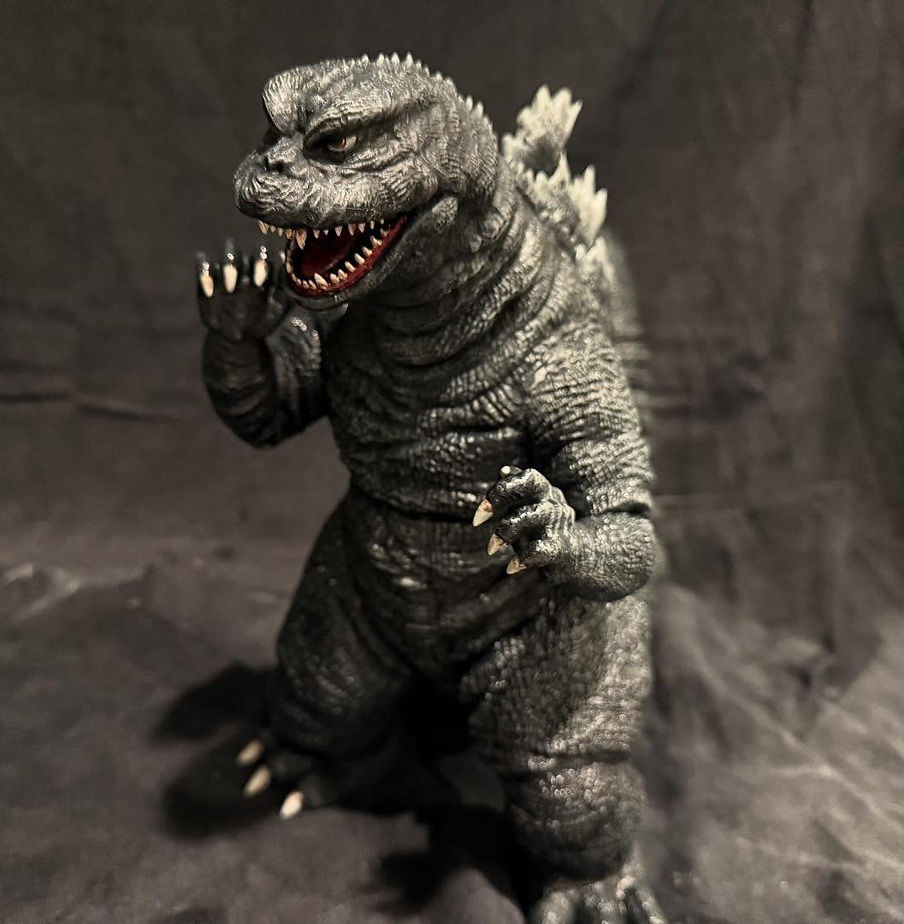
Godzilla (Heisei)
The Heisei Godzilla refers to the version of Godzilla featured in the film series produced between 1984 and 1995, aligning with Japan's Heisei era under Emperor Akihito. This incarnation reboots the original 1954 film, ignoring the sequels that followed it, and presents Godzilla as a terrifying force of nature once again.
Unlike the more heroic or campy portrayals from earlier decades, the Heisei Godzilla is darker, more serious, and more powerful. This Godzilla is bulkier in design, with a more reptilian appearance, larger dorsal fins, and a more menacing demeanor. Throughout the series, he’s portrayed as both a destructive force and a tragic figure, often driven by instinct rather than malice.
The films in this era introduced a deeper continuity, linking stories and character arcs across multiple entries. Godzilla faces both old foes and new adversaries like Biollante, Destoroyah, and Mechagodzilla in battles that often have high emotional and narrative stakes. The Heisei series ends with "Godzilla vs. Destoroyah" in 1995, where Godzilla melts down in a dramatic, fiery climax, symbolizing death and rebirth, as the torch is seemingly passed to his offspring.
Godzilla (Minus One)
"Minus One" Godzilla, from the 2023 film Godzilla Minus One, is a terrifying and primal reimagining of the iconic kaiju. Unlike some of the more heroic or ambiguous versions of Godzilla in previous films, this incarnation is a pure force of destruction—feral, relentless, and deeply symbolic of postwar trauma. Set in post-World War II Japan, the creature embodies overwhelming dread and devastation, arriving at a time when the nation is already at its weakest, both physically and emotionally.
Visually, Godzilla in Minus One is massive and grotesque, with a heavily scarred, almost decaying look. His dorsal fins are jagged and spiny, resembling ancient, fossilized bone, and his face is more skull-like than ever before, with deep-set eyes that give him a haunting, predatory expression. His design evokes fear and awe, emphasizing his role as a monstrous punishment for humanity’s hubris, especially in the context of nuclear war and suffering.
His atomic breath is presented with immense buildup, charging with a blinding white-blue light that culminates in a devastating beam capable of erasing entire city blocks. The destruction he leaves behind is not just physical—it's deeply psychological. In this version, Godzilla isn't just a monster; he's a symbol of the weight of loss, the cost of war, and the inescapable consequences of human error.


Godzilla (Shin)
"Shin Godzilla," also known as "Godzilla Resurgence," is a 2016 Japanese science fiction film that reimagines the iconic monster in a modern context. Directed by Hideaki Anno and Shinji Higuchi, the film portrays Godzilla as a terrifying and evolving force of nature, emerging suddenly in Tokyo Bay and wreaking havoc across Japan. This version of Godzilla is grotesque and ever-changing, starting as a strange, aquatic creature and rapidly transforming into a towering, radiation-emitting beast.
Unlike previous incarnations, Shin Godzilla is presented more as a natural disaster or a biological anomaly than a traditional monster, symbolizing governmental inefficiency and the trauma of national crises, particularly echoing Japan’s response to the 2011 Fukushima disaster.
The film focuses heavily on political and bureaucratic reactions to the threat, showing the chaos, paralysis, and eventual ingenuity of the Japanese government as it attempts to understand and stop the creature. The tone is dark, satirical, and deeply rooted in realism, making Shin Godzilla one of the most politically charged and thematically rich entries in the franchise.